The Real Reason Your Resume Isn't Getting Interviews (It's Not the ATS)
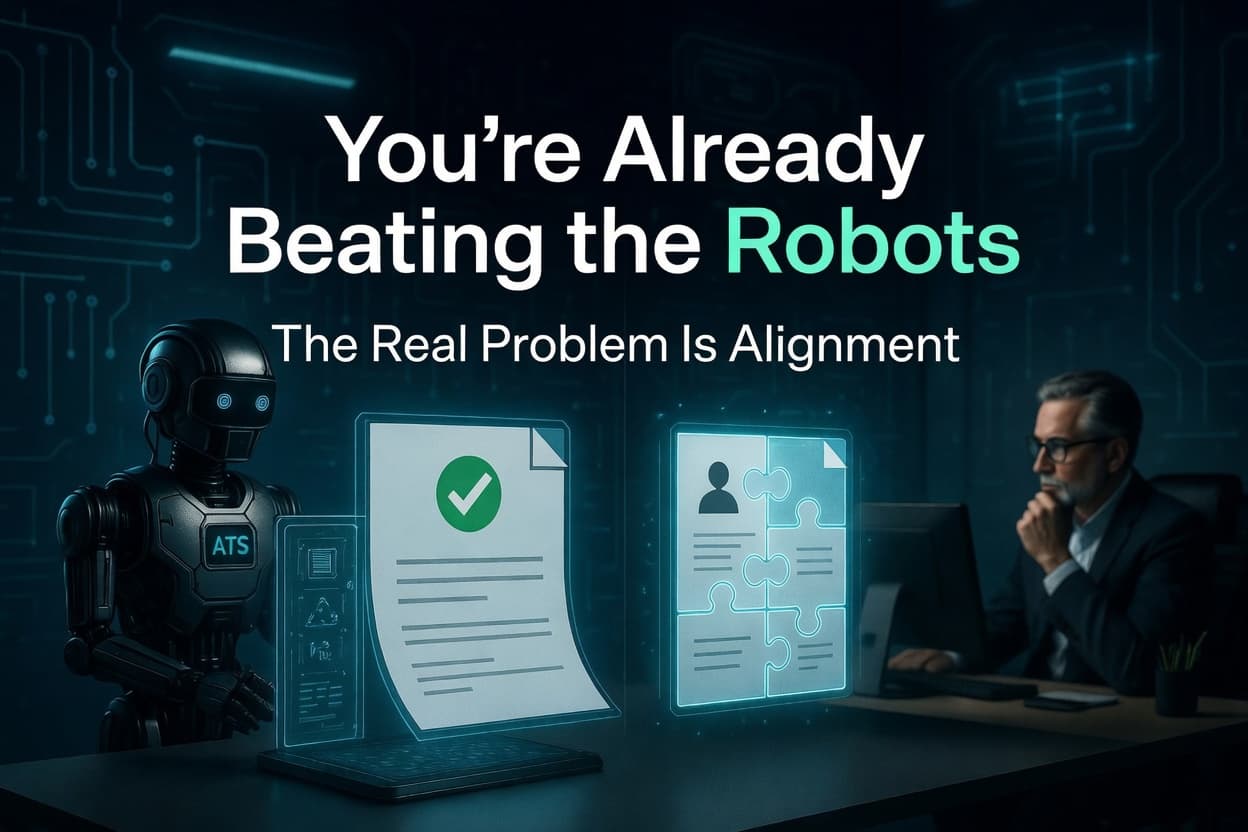
Every job application advice article tells you the same thing: optimize your resume for ATS systems. Use the right keywords. Mirror the job description. Beat the robots.
Here's the uncomfortable truth: you're already beating the robots.
Most resumes clear the ATS filter without issue. The real barrier isn't getting past the software. It's the 15 seconds a hiring manager spends deciding whether you're worth a conversation. And in those 15 seconds, they're asking one question you probably haven't answered: "Does this person actually understand what this role requires?"
We built ResAlign because the entire conversation about resumes and job applications has been focused on the wrong problem.
The Real Problem: Alignment, Not Keywords
The internet is filled with resume optimization tools. Need more keywords? Done. Want a better template? Here are 50. Trying to rewrite your bullet points? AI can do that in 3 seconds.
But none of this addresses why most applications fail. They fail because of a fundamental misalignment between what you think the job requires and what the hiring team actually needs. You see "5 years of Python experience" and think that's the job. They see that requirement as table stakes. What they really need is someone who can architect scalable data pipelines under ambiguous requirements.
The job description is a wish list written by a committee. Your resume is a highlight reel optimized for keywords. Neither document captures what actually matters: whether your specific experience maps to their specific problems.
This is the gap that no amount of keyword stuffing will fix.
What Most Tools Miss
When we started ResAlign, we could have built another resume template generator or a simple keyword matcher that tells you "add these 12 words to your resume." The barrier to entry is low and that's what most people expect.
We took a different path. Most tools help you get slightly better at a broken process. We chose to fix the process itself by building a system that actually assesses fit.
Not keyword overlap. Not resume score. Fit.
That meant building semantic analysis that understands the intent behind job requirements, category-weighted scoring that reflects what actually matters for different role types, skill gap identification with actionable learning paths, and company research integration that contextualizes the role within the company's actual tech stack and challenges.
Could we have shipped faster with a simpler product? Absolutely. Would it have solved the real problem? Not even close.
What This Actually Looks Like
Let me show you what this means in practice. Here's a real example from one of our beta testers (details anonymized):
Before ResAlign:
- Applied to 47 "Senior Software Engineer" roles over 6 weeks
- Got 2 phone screens, both ended after the first round
- Couldn't figure out why her strong backend experience wasn't translating to interviews
After Running 3 Fit Assessments:
She discovered two roles she thought were "perfect matches" were actually poor fits:
- Role A (Series B fintech): 68% fit score. Her microservices experience was strong, but the role heavily weighted DevOps/infrastructure skills she didn't have. The assessment flagged this would be a "stretch" role requiring 3-6 months of runway to get up to speed.
- Role B (Enterprise SaaS): 71% fit. Strong technical overlap, but company research revealed they were in a compliance-heavy vertical where her experience with regulated systems was thin.
The third role looked less impressive on paper but scored 89% fit:
- Role C (Series A dev tools): Her experience building internal developer platforms + API design directly mapped to their core problems. The roadmap identified one gap (GraphQL federation) with a focused 4-week learning path.
She stopped applying to everything. She focused on Role C, used the skill gap analysis to prep for the technical discussion, and landed a final-round interview in 11 days.
Here's what the actual fit assessment looked like for Role C:
📊 Sample Fit Assessment Output
FIT ASSESSMENT: Senior Platform Engineer @ DevTools Co
Confidence: High
CATEGORY BREAKDOWN
Technical Skills (35% weight)
92%- ✓Microservices architecture (5 years at Series B startup)
- ✓API design & REST patterns (strong portfolio evidence)
- ⚠️GraphQL federation (gap: 4-week learning path recommended)
Experience Match (25% weight)
88%- ✓Internal dev tools at 200+ eng org aligns with "platform for 500+ devs"
- ✓Series A/B growth stage experience (1-50 → 200 eng scaling)
Domain Knowledge (15% weight)
76%- ✓Developer experience focus matches their product vision
- ⚠️Limited exposure to open-source community building
Soft Skills & Culture (15% weight)
91%- ✓"Bias for action" + autonomy examples throughout resume
- ✓Strong technical writing (blog + docs portfolio)
Role Level Match (10% weight)
94%- ✓6 YoE aligns with "5-8 years" requirement
- ✓Senior IC scope matches (no unexpected manager expectations)
🎯 KEY INSIGHTS
Strong Alignment Areas:
- • Your internal platform work at Stripe directly maps to their core product (developer productivity tooling for large eng orgs)
- • API design experience is rare at this level + highly valued here
- • Your "dogfooding" philosophy matches their "build for developers, by developers" culture
⚠️ Skill Gaps to Address:
1. GraphQL Federation (Medium Priority)
4-week learning path: Apollo Federation Fundamentals → Build sample gateway project
Why it matters: 40% of their interview case studies involve GraphQL architecture
2. Open-source community building (Low Priority)
Not required for interview, but could strengthen culture fit discussion
💡 Company Context:
- • Series A, $12M raised (Dec 2025), 38 employees (22 eng)
- • Tech stack: Go, TypeScript, Kubernetes, GraphQL
- • Recent pivot from horizontal dev tools → vertical focus on platform eng teams
- • Hiring urgency: High (3 platform roles open, CEO tweeted about scaling challenges)
✅ RECOMMENDATION: APPLY NOW
This is a high-probability match.
Next Steps:
- 1. Spend 1 week on GraphQL federation basics (use our learning path)
- 2. Tailor your cover letter to emphasize internal platform experience
- 3. In your application, reference their recent blog post "The Platform Team's Dilemma"
Estimated interview probability if you apply: 68% (vs. 12% baseline for your profile)
Beta testers are seeing similar results. Another user (ex-FAANG, 4 YoE) went from 0 responses on 30 applications to 4 recruiter outreaches in 2 weeks after focusing only on roles with 82%+ fit scores.
Here's What Changes for You
Instead of spending weeks applying to roles that were never going to work out, you'll know within minutes where you actually have an advantage. You'll see:
Exactly where you're strong and where you're misaligned, weighted by what actually matters for each specific role. Not "you mentioned Python 5 times, and the JD mentioned it 8 times." Real strategic intelligence about how your experience maps to their problems.
The fastest path to close any gaps. Curated resources, sequenced learning paths, realistic timelines. Sometimes the best career move is investing 6 weeks learning something new rather than spending 6 months applying to jobs you're not ready for.
Company context that makes vague phrases concrete. The JD says "fast-paced environment." You'll see they're a 50-person Series A with a 6-month runway and a product pivot underway. Suddenly, that phrase means something, and you can decide if that's the chaos you want.
Why This Matters Now
AI has made it trivially easy to apply to 100 jobs in an hour. But it's also made it trivially easy for companies to receive 1,000 applications for every role. The result? A broken equilibrium where everyone is spending more time than ever on a process that's less effective than ever.
The solution isn't better spam. It's better signal.
The next generation of career tools won't be about helping you play the volume game better. They'll be about helping you opt out of the volume game entirely, and giving you the strategic intelligence to compete where you have an actual advantage.
We're starting with fit assessment, but this is just the beginning. Imagine having an AI career advisor that knows not just your resume but your actual capabilities, your learning velocity, your career goals, and your life constraints. And uses all of that to guide you toward opportunities that are genuinely aligned.
What's Next
This is the first post of many. We're going to share:
- How we built our semantic matching engine (and why embedding similarity alone fails)
- Deep dives into what "fit" actually means for different role types
- Case studies of real alignment transformations
- Honest postmortems when we get things wrong
We're also listening. If you're using ResAlign (or considering it), we want to hear what's working, what's not, and what problems we should be solving next.
Reply with the job posting you're most excited about, and I'll personally review the fit for the first 50 responses. Shoot us an email at nikhil@resalign.com, find us on X/Twitter or LinkedIn.
The job search is broken. We're not going to fix it overnight. But we're going to start by giving you something the current system doesn't: honest, strategic intelligence about where you actually belong.
Ready to Stop Wasting Time on Misaligned Applications?
Get your personalized fit report + learning roadmap for any job you're considering.
Your first 3 assessments are free during early access. No credit card required.
Have thoughts on this post? Reply to this email or find me on X/Twitter / LinkedIn. I read every message.